31/08/2026
News
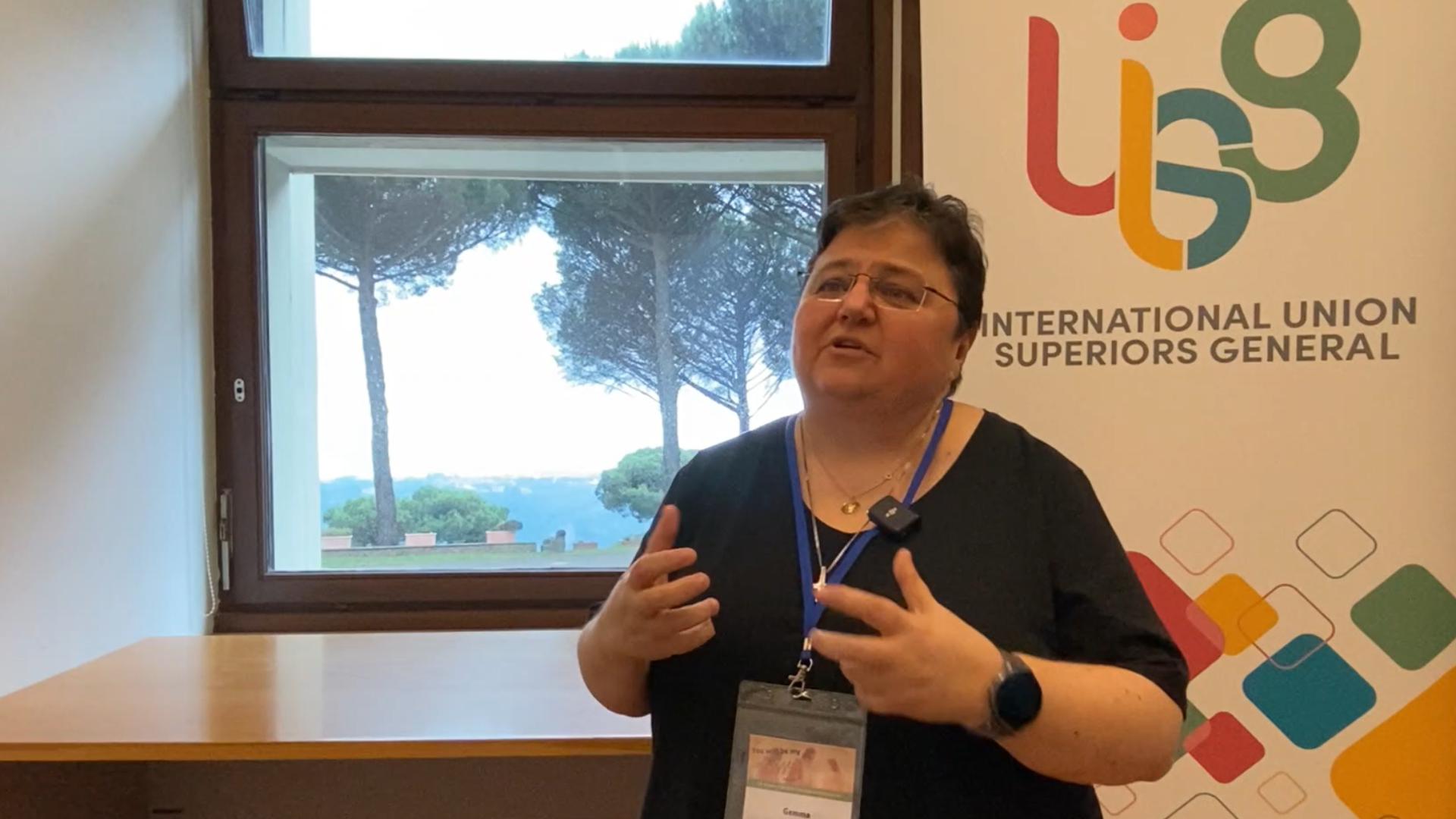
Sr. Gema Morató Sendra’s experience at the Symposium of Women Religious Theologians in Nemi: “Let us open up broad horizons where everyone has a place.”
Sr. Gema Morató Sendra’s experience at the Symposium of Women Religious Theologians in Nemi: “Let us open up broad horizons where everyone has a place.”
From 30 May to 7 June 2026, women religious theologians from different continents and congregations gathered in Nemi to build networks and place their theological expertise at the service of consecrated life.
Sr. Gema Morató Sendra, of the Dominican Sisters of the Presentation, who participated in the Symposium, shares her experience with us.
In a world marked by war and violence, what contribution can theology developed by consecrated women offer?
Well, first of all, we need to ensure that the theology produced by consecrated women becomes visible. Then, I believe we can open many paths that are firmly grounded in reality, touching the concrete experiences of life, both in its joys and in its sufferings.
What are the main challenges the Church is called to face in order to bear witness to the Gospel in an increasingly secularized and fragmented society?
I live in Europe, and it is indeed a highly secularized society, although there is also a renewed interest in spirituality. At the same time, it is a deeply polarized society, where people often seem interested in creating even more division and polarization. I believe that what we can offer is a message of communion and synodality, in the spirit of Pope Leo XIV: sitting at the same table, different, yet united. We need to overcome this tendency to divide, which has also found its way into our own communities.
Let us come together and recover certain words that I often say the world—and we ourselves—have almost erased from our vocabulary: communion, peace, commitment, values, and humility. We need great humility to sit down together again, to share what we truly think without fear and without falling into the tyranny of uniform thinking.
If you could leave one message for the leaders of religious congregations on behalf of consecrated women, what would it be?
The message I would address to all congregations, and especially to major superiors, both women and men, is: formation, formation, and more formation. Theological formation, formation in religious studies, but also formation in the civil and social sciences. We cannot engage in dialogue with the world if our level of formation is minimal or superficial.
We must invest in formation. Whether we like it or not, we have to overcome the fear of investing in people because we wonder what might happen afterwards. Even if things do not turn out as we hoped, we will still have a Christian—woman or man—who is well formed and able to serve the world.
If this Symposium were represented by an image or an icon, what would it be?
For me, the image is very clear, especially here in Nemi, surrounded by this landscape. It is an invitation to open new paths and broaden our horizons. That is the image I carry away.
Let us step out of the bubbles we sometimes create for ourselves and open wide horizons where everyone has a place. Let us also be willing to break through rigid ways of thinking and embrace broader horizons.
What significance does a Symposium like this, bringing together women theologians from all over the world, have for you?
For me, the greatest significance of this Symposium is realizing that you are not alone. Many of us serve in mission settings or countries where we can sometimes feel isolated. I come from Catalonia, in Spain, where this can certainly be the case. Here, however, you discover that you are not alone—that there are others who think and struggle for the same things, some of whom face even greater challenges. Realizing that others share your hopes and convictions gives you tremendous encouragement and strength.
Pope Leo will soon visit Spain. As a Spanish theologian, what does this visit mean to you?
That question touches me deeply because we are about to welcome the Pope, and because I have just published a book about him that captures much of what you are asking. The book is called The Hinge Pope, because I believe the Pope is truly like a hinge. A hinge is something discreet and almost invisible, yet without it doors cannot open.
The Pope opens doors, builds bridges, and seeks ways for people to encounter one another—to unite rather than divide. In Barcelona especially, we will see two powerful images.
For me, these are beauty and poverty—or vulnerability. On the one hand, there is the beauty and grandeur of the Sagrada Família and Montserrat; on the other, the poverty and vulnerability expressed through his visit to a prison and to a parish in a very central yet vulnerable neighborhood of Barcelona. In doing so, the Pope shows us that there are different paths to encounter God, and that we are called to walk both of them.
Related News
 News
Monday 28 September 2026
Sister Maria Rita: “Everyone, everyone, everyone, a Church where everyone has a voice, a place and a space”
Read
News
Monday 28 September 2026
Sister Maria Rita: “Everyone, everyone, everyone, a Church where everyone has a voice, a place and a space”
Read
 News
Monday 21 September 2026
Sister Joséphine’s Experience at the Symposium of Women Religious Theologians in Nemi: “We Are Gathered Around Christ to Reflect on Our Consecrated Life”
Read
News
Monday 21 September 2026
Sister Joséphine’s Experience at the Symposium of Women Religious Theologians in Nemi: “We Are Gathered Around Christ to Reflect on Our Consecrated Life”
Read
 News
Monday 14 September 2026
Sr. Ha Dinh's experience at the Women Religious Theologians Symposium in Nemi: “The gathering was like a contemporary Pentecost.”
Read
News
Monday 14 September 2026
Sr. Ha Dinh's experience at the Women Religious Theologians Symposium in Nemi: “The gathering was like a contemporary Pentecost.”
Read
 News
Monday 07 September 2026
Sr. Clementina Carbone’s Experience at the Symposium of Women Religious Theologians in Nemi: “Building Networks Makes Us Stronger”
Read
News
Monday 07 September 2026
Sr. Clementina Carbone’s Experience at the Symposium of Women Religious Theologians in Nemi: “Building Networks Makes Us Stronger”
Read
02/09/2026
Agnes Okoye
The interview is wonderful. I love what Sr. Gema said about the impact of our Conference in Nemi: that you know you are not alone but now have fellow women religious theologians journeying with you. I feel the same, and it is a source of strength for me. Well done, Gema!