12/04/2026
News
Transformed by Hope – Divine Mercy Sunday: “Peace be with you”
Transformed by Hope – Divine Mercy Sunday: “Peace be with you”
“Transformed by Hope” is proposed as a space of listening and discernment on the Sunday Gospels that accompany our journey.
This initiative is situated within the horizon opened by the Jubilee and seeks to extend its grace, continuing to live our vocation as pilgrims of hope amid the challenges of our time.
Each week, in the light of the Word of God, we contemplate an aspect of the conversion to which we are called, allowing ourselves to be guided by the Spirit.
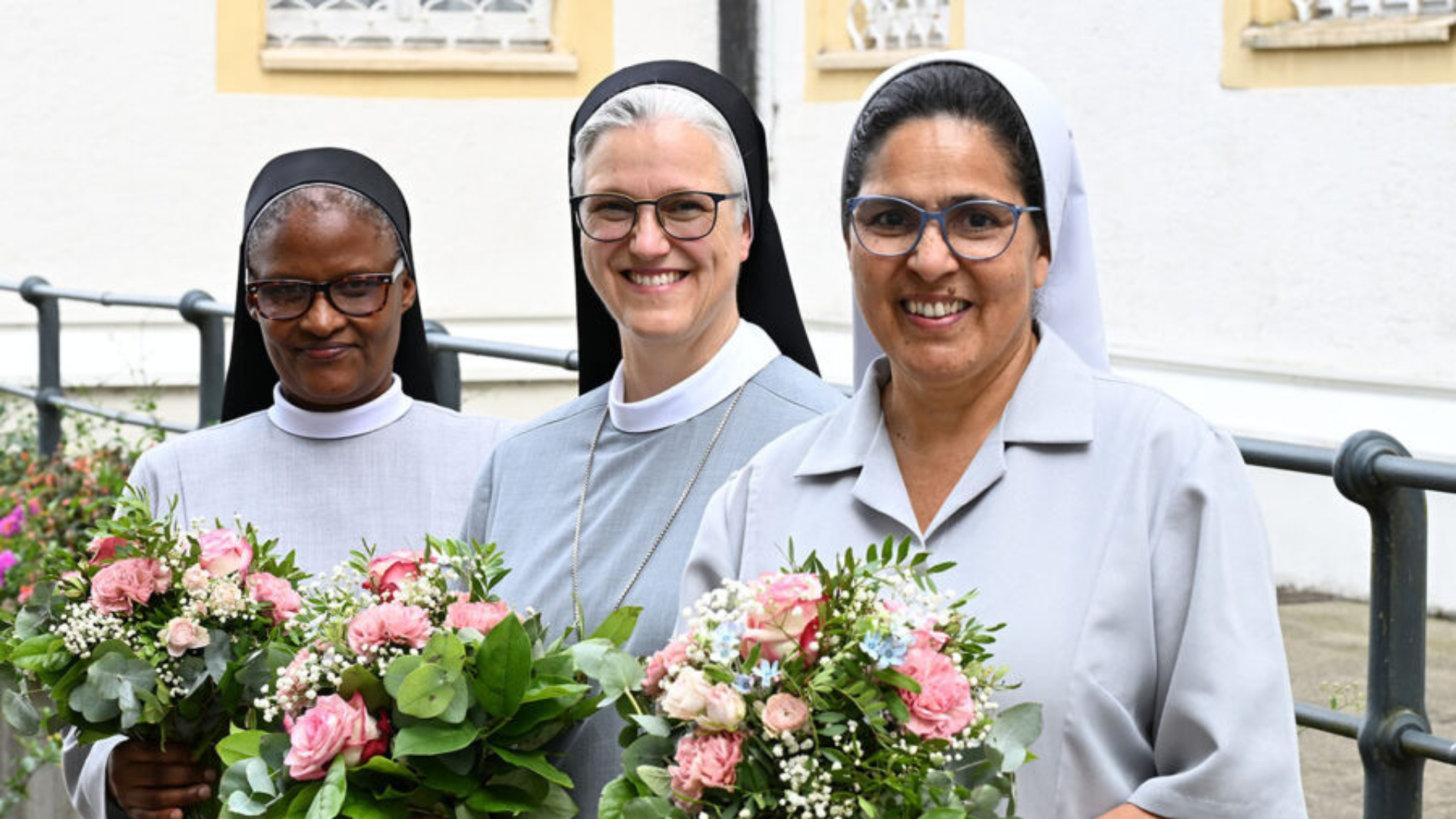
For Divine Mercy Sunday, the Gospel reflection is accompanied by the meditation of Mother Rita Tenerezza Ocloo, Superior General of the Sisters of the Visitation of Holy Mary and coordinating delegate of the Italy Constellation - C8.
On this Sunday of Divine Mercy, we are called to meditate on the Gospel of John (20:19-31), which presents two main scenes: first, the appearance of the risen Christ to the disciples locked away in fear, and then Jesus' encounter with Thomas, who was absent during the first visit. This Gospel is immensely rich in spiritual meaning, as it speaks of fear, mission, mercy, faith, and the presence of the risen Christ within a fragile community. Read in the light of women's religious life, this text becomes particularly fruitful: it illuminates how Consecrated women are called to live the Paschal faith, to bring the peace of Christ, to become signs of hope, and to believe even when experiencing difficulties, silence, or uncertainty.
The first powerful image is that of the disciples shut away: "the doors were closed for fear." This fear is not just a psychological detail; it symbolizes the inner state of a wounded and disappointed community, still marked by the Passion. Jesus then came among them without reproach or condemnation. His first words were: "Peace be with you." The Risen Lord did not start by asking why; He started by restoring peace. For religious life, this detail is essential. Many Consecrated women today also experience forms of "closed doors": apostolic fatigue, loneliness, lack of vocations, aging communities, misunderstandings in their mission, and sometimes even inner discouragement. Yet, the risen Christ does not stand outside these realities; He enters exactly where the fragility is greatest.
Therefore, in a religious community, when a consecrated woman goes through a period of spiritual dryness, when a superior must take on heavy responsibilities, or when a congregation questions its future, this Gospel recalls a fundamental truth: Resurrection often begins in the very heart of what seemed blocked or lost. When we allow the Risen Lord to enter "into the midst of our fragilities," these difficulties become a place of renewal, apostolic creativity, and deeper fidelity.
In a second moment, after giving His peace, Jesus shows His hands and His side. The Risen Lord does not erase the wounds of the Cross but keeps them transfigured. This means that Christian glory is not an escape from suffering, but its transformation into love. This point resonates deeply with our religious vocation. A Consecrated woman is not called to an ideal life without wounds, but to live a life of offering where her own wounds can become a source of compassion for others. Many consecrated women thus become presences of healing in the Church and the world because they have learned to present their own wounds to Christ.
Think, for example, of our service to the sick, women victims of violence, abandoned children, prisoners, victims of human trafficking, and the lonely elderly. Our fruitfulness comes not only from our skills but from this evangelical capacity to love with a heart pierced by Christ. A consecrated woman who has personally experienced suffering can more deeply understand another in a similar situation. Like Jesus showing His wounds, religious life thus becomes a testimony to the fact that wounds offered to God can become a place of life.
Jesus then continues, saying: "As the Father has sent me, so I send you." The peace received is therefore never a peace turned inward; it becomes mission. This is a crucial point for consecrated life. As consecrated women, we are not only called to "live with God" in a private relationship, but to be sent. Our whole life is missionary, even when not performing a visible apostolate. Regardless of the nature of our missions—be it a contemplative praying in a monastery, a teacher in a school, a nurse in a clinic, a catechist in a village, or a spiritual director in a nursing home—all participate in this mission of Christ.
In many contexts, a consecrated woman who supports works of mercy or other activities makes visible the words of the Risen Lord: "I send you." She does not act simply as a social worker or educator; she is a sign of a living Christ who continues to reach out to His people.
The next gesture is even more powerful: Jesus breathes on them and says, "Receive the Holy Spirit." This breath recalls the creation of Adam in Genesis. The Risen Lord recreates His community. He generates a new people. For Consecrated life, this means that no lasting fidelity is possible without the breath of the Spirit. A community may have rules, structures, works, and a magnificent history, but without the Holy Spirit, it withers. It is the breath of the risen Christ that allows a consecrated woman to continue loving in the monotony of daily life, in the repetition of simple tasks, and in hidden, unacknowledged acts of service.
Think of a consecrated woman who, for thirty years, has cooked for a community, or an elderly sister who can no longer go out but prays daily for the missions, or a novice patiently learning the realities of community life despite personality differences. Outwardly, this may seem ordinary. Yet, it is often in these situations that the Holy Spirit molds us into holiness. Consecrated life demonstrates that God's breath operates even in discreet, humble, and persevering fidelity.
The text then highlights Thomas, the one who doubts. He wants to see, touch, and verify. Sometimes we tend to judge him harshly, but in reality, he represents many of us. His difficulty in believing is similar to ours. Sometimes we find ourselves asking: "Is Christ truly here? Is my vocation still bearing fruit? Does my commitment make sense?" Doubt is not always synonymous with infidelity; all these doubts/questions can be a stage in the purification of faith.
The wonderful thing is that Jesus does not reject Thomas. Eight days later, He comes back for him. This is very important for women's community life: Christ meets each of us where we are. A religious community is not made up of perfect women, but of women on a journey. Some proceed with a serene faith; others go through inner struggles. True sisterhood, therefore, consists in not excluding those who doubt, those who are slower, those who are wounded or more fragile. An evangelical community is a community that knows how to wait, support, listen, and accompany.
We might think of a young sister in formation experiencing a vocational crisis after a few years of profession, or a sister returning marked by a difficult experience from her mission. A Paschal community will not say, "She just needs to get over it," but will try to make space for her, just as Jesus made space for Thomas until he could reaffirm his faith.
The climax of the passage is Thomas's confession: "My Lord and my God!" This statement is one of the most beautiful professions of faith in the entire Gospel of John. Thomas moves from doubt to adoration. For a religious woman, this statement can become a true spiritual program. Consecrated life is not primarily a set of tasks, schedules, or responsibilities; it is fundamentally a response of love to Christ, recognized as Lord and God. A faithful consecrated woman is first and foremost a woman who, in the midst of her daily life, inwardly proclaims: "My Lord and my God."
This profession of faith takes concrete form in prayer, the Eucharist, the Liturgy of the Hours, service to the poor, fraternal life, obedience, consecrated chastity, and evangelical poverty. When a sister gives of herself to serve a sick sister, when she chooses patience over harshness, when she remains faithful to prayer despite dryness, she says with her actions: "My Lord and my God."
Finally, Jesus concludes with a beatitude that deeply touches our time: "Blessed are those who have not seen and yet have believed." This statement is particularly illuminating for religious life today. Many consecrated women serve in contexts where they do not immediately see the fruits of their mission. They teach without always seeing the results, pray for intentions without a visible response, accompany people who do not change immediately, and work in the shadows. Yet, they continue to believe. This faith without seeing is a great beauty of consecrated life. It allows us to experience this beatitude to which the Risen Lord invites us: to believe without seeing immediately.
I could summarize that the Gospel of John 20:19-31 is a Paschal text that speaks powerfully to religious life. It reminds us that the Risen Christ enters the closed spaces of our fears, transforms wounds into a source of life, gives His peace, sends us on mission, infuses His Spirit, accompanies us in moments of doubt, and leads us to a deeper faith. In the light of this Gospel, a consecrated woman appears as a woman of Easter: a woman who welcomes the peace of Christ, who lives by His Spirit, who serves despite trials, and who becomes in the Church a discreet but powerful sign of the Resurrection.
12/04/2026
Se Caterina Lacancellera
Grazie. L'articolo ci aiuta a meditare più da vicino e in un modo specifico la relazione di Dio con ognuno di noi. Lui è Pace, incontro e trasformazione
Related News
 News
Monday 14 September 2026
Sr. Ha Dinh's experience at the Women Religious Theologians Symposium in Nemi: “The gathering was like a contemporary Pentecost.”
Read
News
Monday 14 September 2026
Sr. Ha Dinh's experience at the Women Religious Theologians Symposium in Nemi: “The gathering was like a contemporary Pentecost.”
Read
 News
Monday 07 September 2026
Sr. Clementina Carbone’s Experience at the Symposium of Women Religious Theologians in Nemi: “Building Networks Makes Us Stronger”
Read
News
Monday 07 September 2026
Sr. Clementina Carbone’s Experience at the Symposium of Women Religious Theologians in Nemi: “Building Networks Makes Us Stronger”
Read
 News
Wednesday 02 September 2026
VI International Meeting of the Dominican Sisters of Saint Catherine of Siena: “Sowers of Hope that Transforms”
Read
News
Wednesday 02 September 2026
VI International Meeting of the Dominican Sisters of Saint Catherine of Siena: “Sowers of Hope that Transforms”
Read
 News
Friday 28 August 2026
New General Leadership of the Franciscan Sisters of Siessen
Read
News
Friday 28 August 2026
New General Leadership of the Franciscan Sisters of Siessen
Read
13/04/2026
Ana María
Es enriquecedor está oferta de una interiorización de la Palabra. Ñachec.Gracias.