02/05/2026
Noticías
Consecrated Life in Dialogue with Artificial Intelligence: Safeguarding the Human in the Digital Age
Consecrated Life in Dialogue with Artificial Intelligence: Safeguarding the Human in the Digital Age
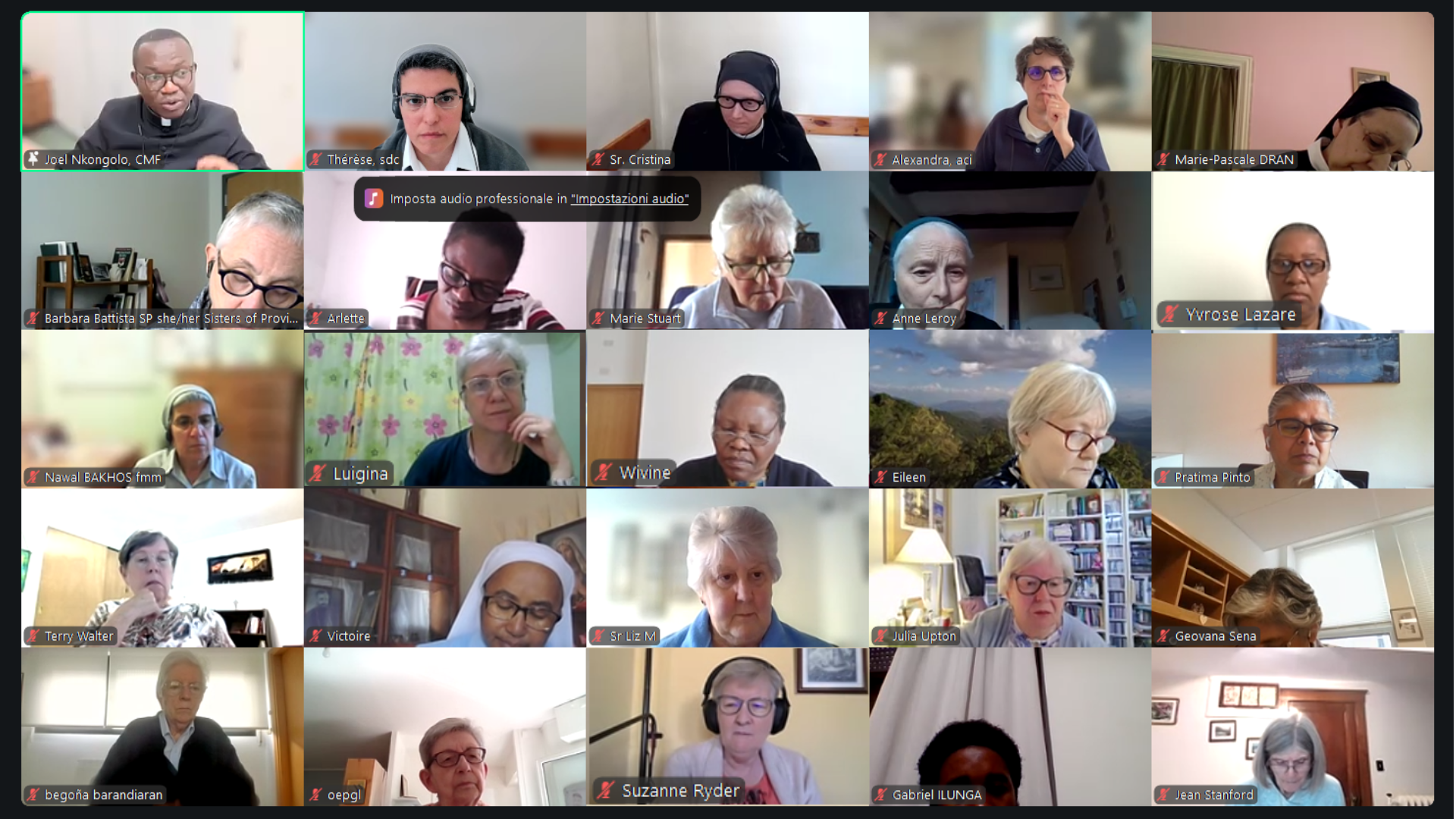
On April 29, 2026, the webinar “Consecrated Life in Dialogue with Artificial Intelligence: Spiritual, Ethical and Pastoral Implications” took place online, organized by MMI in collaboration with UISG (International Union of Superiors General) and USG (Union of Superiors General).
More than 500 participants from around the world took part: communicators, members of religious congregations, formation leaders, and pastoral workers, all seeking to understand how artificial intelligence is impacting the mission of the Church.
The speaker was Fr. Joel Nkongolo, CMF, who offered a solid reflection deeply rooted in the Church’s tradition, approaching the topic not as a technical issue but as an anthropological, spiritual, ethical, and pastoral challenge.
Questions already present in consecrated life
The presentation opened with increasingly concrete questions: Is it appropriate to use AI to prepare a homily? Can someone in formation rely on a chatbot for accompaniment? Is it wise to use free tools to manage sensitive documents?
Questions that, until a few years ago, would have seemed unlikely, now arise in chapters, councils, and formation processes—clear signs that AI is no longer a future issue but a reality already present in the daily life of institutes.
A key perspective: Christian anthropology
Fr. Joel’s thesis was unequivocal: artificial intelligence can serve the mission of consecrated life only if it is interpreted in the light of a Christian vision of the human person.
Referring to the Note Antiqua et Nova, he emphasized that AI lacks interiority, consciousness, and the capacity for authentic relationships: it produces plausible content but does not know, believe, or love.
It is precisely what AI cannot do that highlights what remains essential for consecrated life.
Three dimensions for discernment
Fr. Joel showed how AI challenges consecrated life across three deeply interconnected dimensions.
On the spiritual level, he pointed to the risk that ever-available tools, such as chatbots, may replace essential inner processes—silence, waiting, discernment—especially in formation.
From an ethical perspective, he stressed the need to maintain human responsibility in decision-making, ensuring truth, data protection, and the safeguarding of the most vulnerable, particularly within a context shaped by new forms of global dependency.
Finally, on the pastoral level, he reaffirmed that accompaniment cannot be automated: digital tools may assist, but they cannot replace presence. The risk, he noted, is to confuse efficiency with encounter, and content with relationship.
A decisive criterion
Among the proposed criteria, one key question emerges:
Does this use of AI serve encounter, or does it replace it?
Fr. Joel was very clear: if it supports the mission and frees time for relationships, it can be a useful tool. If it displaces or empties them, it must be reconsidered.
A prophetic responsibility
Consecrated life, the speaker emphasized, safeguards dimensions that AI cannot replicate: silence, prayer, fraternal life, accompaniment, and presence among the poor.
In an increasingly technological world, these realities are not marginal—they are even more necessary and prophetic.
An image for our time
In conclusion, Fr. Joel offered a powerful image drawn from Antiqua et Nova: artificial intelligence is “a pale reflection of humanity.”
A reflection exists because there is a face.
The question, therefore, is not to destroy the mirror, but to continue being faces—faces capable of relationship, listening, responsibility, and concrete love.
Faces that no algorithm can replace.
In a time when machines increasingly imitate human language, consecrated life is called to make visible what remains irreducible: the encounter with God and with others, lived in the concreteness of life.
This is, today, its most necessary witness.
News relacionadas
 Noticías do Vaticano
Terça-Feira 03 Março 2026
Um passo importante no caminho sinodal
Ler
Noticías do Vaticano
Terça-Feira 03 Março 2026
Um passo importante no caminho sinodal
Ler
 Noticías do Vaticano
Segunda-Feira 26 Janeiro 2026
Cuidar das vozes e dos rostos humanos: a Mensagem do Papa Leão para o 60º Dia Mundial das Comunicações Sociais
Ler
Noticías do Vaticano
Segunda-Feira 26 Janeiro 2026
Cuidar das vozes e dos rostos humanos: a Mensagem do Papa Leão para o 60º Dia Mundial das Comunicações Sociais
Ler
 Noticías do Vaticano
Quinta-Feira 15 Maio 2025
Irmãs reportando das margens: Jornalismo para irmãs religiosas
Ler
Noticías do Vaticano
Quinta-Feira 15 Maio 2025
Irmãs reportando das margens: Jornalismo para irmãs religiosas
Ler
 Noticías do Vaticano
Segunda-Feira 12 Fevereiro 2024
Projeto Pentecostes: Curso online para Irmãs
Ler
Noticías do Vaticano
Segunda-Feira 12 Fevereiro 2024
Projeto Pentecostes: Curso online para Irmãs
Ler
Projectos e Comissões relacionados

Comunicar a vida religiosa
Saber mais